When AI or data initiatives slow down, the default explanation is almost always the same:
“We need more engineers.”
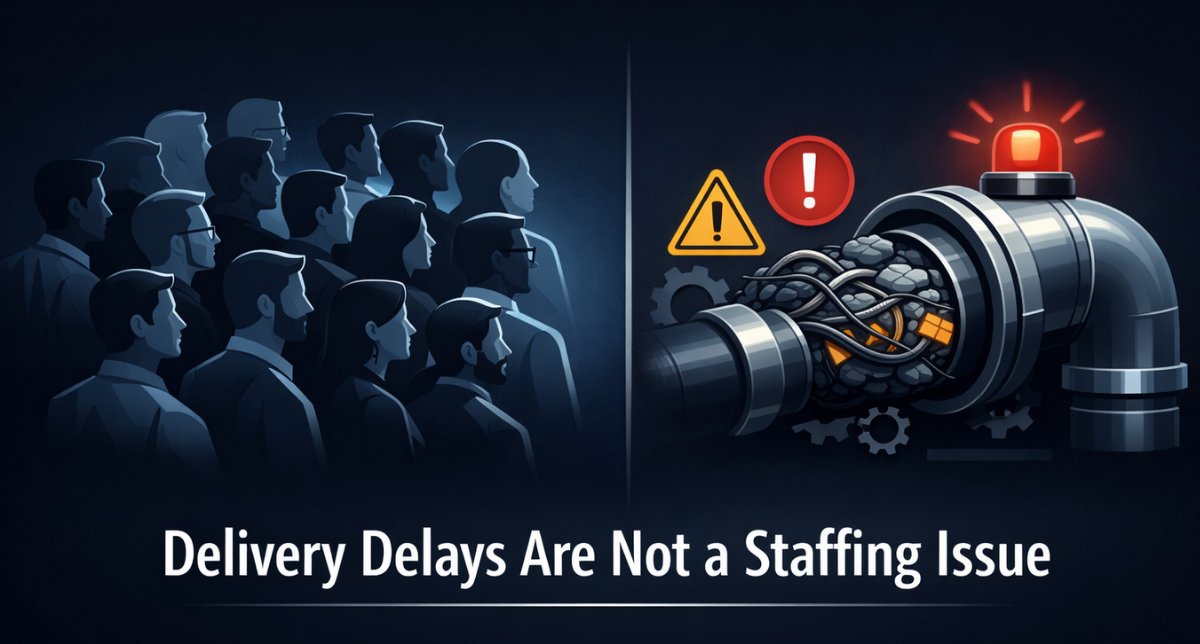
In practice, delivery delays are rarely caused by insufficient staffing.
They are caused by how work flows — and where it quietly breaks down.
Until that’s addressed, adding people increases cost without restoring speed.
Why staffing feels like the obvious fix
Hiring feels concrete.
It signals action.
It reassures stakeholders.
It avoids uncomfortable conversations about ownership and decision-making.
But new hires don’t fix:
- late inputs
- unclear decision rights
- fragmented accountability
- brittle pipelines
- rework caused by upstream ambiguity
They inherit them.
What delivery delays actually look like
Across AI and data-heavy organizations, the symptoms are consistent:
- pipelines fail unpredictably
- data quality degrades under pressure
- AI initiatives stall in review
- senior engineers spend most of their time unblocking
- roadmaps slip without a clear technical explanation
These are not capacity problems.
They are workflow problems.
Add up enough of these small workflow problems and you get exactly the kind of month where nobody can account for where the time went
(see: why teams lose 20+ days a month to workflow friction, not headcount).
Why more people rarely increase speed
When workflows are unclear:
- onboarding slows progress
- coordination overhead rises
- ownership fragments further
- handoffs multiply
- decision latency increases
The organization gets busier — not faster.
This is why teams can grow significantly without meaningful delivery acceleration.
The real constraint on delivery speed
Delivery is constrained by a small number of upstream factors:
- work starts before inputs are ready
- ownership breaks across teams
- escalation paths are unclear
- compliance enters too late
- fixes are applied downstream
- senior time is consumed by firefighting
Until these are addressed, staffing changes are irrelevant.
Why AI delivery amplifies the issue
AI initiatives make workflow friction more expensive because:
- they span more systems
- failures surface later
- compliance expectations are higher
- business impact is larger
When ownership and sequencing are unclear, teams default to caution.
This is how AI initiatives drift quarter after quarter without formally failing
(see: The ROI Lost Each Month You Delay AI).
What actually restores delivery speed
Teams that recover momentum don’t hire first.
They trace one real AI or analytics workflow end-to-end and make friction visible:
- where work stalls
- why it resets
- who gets pulled in
- how much time is lost
- which fixes return the most capacity
Once those constraints are visible, fixes are smaller and faster than expected.
This is the same upstream visibility gap that slows delivery long before a model ever runs
(see: The Silent Cost of Late or Bad Data).
Why short, focused engagements work
Most organizations don’t need a transformation.
They need clarity.
Fixing the top one or two delivery bottlenecks often returns more capacity than months of hiring.
That’s why focused audits outperform long programs.
The test before you hire
Before adding headcount, there’s a cheaper test: pick the one workflow that’s slipping the most, and watch where it actually stalls for two weeks. Not where the org chart says the work should flow — where it actually does.
Most of the time, the stall point is a single ownership gap or a single unclear handoff, not a shortage of hands. Fixing that one point is faster and cheaper than a hiring cycle, and it tells you whether more people would even help.
How to determine if staffing is really the problem
If any of the following are true:
- senior engineers are always “helping”
- delivery depends on heroics
- pipelines technically work but feel fragile
- AI initiatives slow in review
- teams are busy but outcomes are unpredictable
You likely don’t have a staffing problem.
You have a delivery visibility problem.
How to get clarity
Tracing one workflow end-to-end usually answers the staffing question directly: either the constraint is a real capacity gap, or it’s a handoff nobody owns. Only one of those is solved by hiring — and you won’t know which until you look.