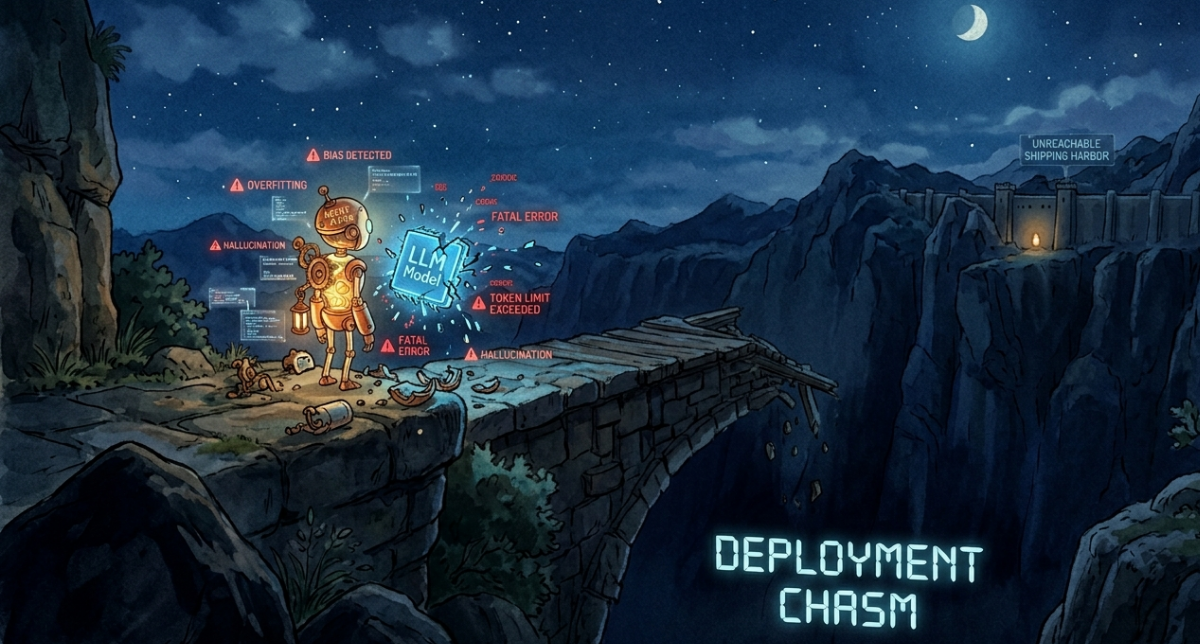
Every major technology vendor is announcing agent capabilities.
Every conference session covers autonomous AI workflows.
Every roadmap has agentic AI somewhere on the horizon.
And most enterprise agent deployments never reach production.
This is not a model problem.
It is a delivery problem — and the same structural failures that stall traditional AI initiatives are amplified by the demands of autonomous systems.
What makes AI agents different from traditional AI
Traditional AI systems produce outputs that humans review before acting.
A model generates a recommendation. A person decides whether to follow it. If the model is wrong, the cost is a bad recommendation — caught before it causes harm.
AI agents operate differently.
They reason across multiple steps, take actions using tools, call external systems, and produce downstream effects without human review at each step. If the agent is working from stale data, misunderstands the task context, or encounters an unexpected system state, it doesn’t pause to ask — it acts.
The cost of a failure is not a bad output.
It is a sequence of automated actions taken on a bad premise.
This is why the foundation that agents operate on matters more than the models themselves.
The four reasons most enterprise agents fail before they ship
1. Data pipelines that are not reliable enough for autonomous action
Traditional AI can tolerate moderate data quality issues. A model might produce a slightly less accurate recommendation — but a human still reviews the output before anything happens.
Agents cannot tolerate the same margin.
When an agent acts on stale, incomplete, or incorrect data, its downstream actions compound the error. By the time the issue is detected, multiple automated steps have already executed.
Organizations that have not resolved their data reliability issues before deploying agents discover this in production — at the worst possible moment:
2. Ownership that doesn’t account for autonomous failure modes
When a traditional model produces a bad output, ownership is relatively clear. The ML team owns the model. The data team owns the inputs.
When an agent takes a bad action, the ownership question becomes more complex.
- Who owns the action the agent took?
- Who is responsible for the downstream systems the agent affected?
- Who has the authority to roll back or correct?
Organizations with unclear ownership for traditional AI systems find that agentic AI makes those gaps immediately dangerous:
3. Evaluation environments that don’t reflect production
Agent demos work because demo environments are controlled.
Data is clean. External systems behave predictably. Edge cases don’t appear.
Production is different.
When agents move from evaluation to production, they encounter the full complexity of real workflows — ambiguous inputs, unexpected system states, downstream dependencies with their own failure modes.
Organizations that ship agents without rigorous production-condition evaluation discover this gap immediately:
4. Observability not designed for multi-step reasoning
Traditional observability tracks whether a system is up and whether outputs are within expected ranges.
Agent observability requires tracking something fundamentally different: whether the agent’s reasoning across a sequence of steps remained coherent — and whether each action it took was appropriate given the actual context.
Most observability stacks are not built for this. Teams deploy agents with the same monitoring they use for APIs and pipelines — and discover that agent failures are nearly invisible until they produce downstream consequences:
Why delivery problems amplify in agentic systems
Every structural weakness in a traditional AI delivery system is amplified in an agentic one.
Fragile pipelines become more dangerous when agents depend on them for real-time decisions.
Ownership gaps become more expensive when no one knows who is accountable for an autonomous action.
Slow delivery cycles become more costly when agent behavior needs rapid iteration based on production feedback.
Governance gaps become higher-risk when agents operate on regulated data without human review at each step.
This is why organizations that have not resolved their delivery foundations cannot safely deploy agents — even when the model capabilities are ready:
What production-ready agents actually require
Organizations that deploy agents with confidence share a common prerequisite:
They resolved the underlying delivery and data foundations before the agents needed to rely on them.
Specifically:
- data pipelines are reliable, monitored, and clearly owned
- pipeline failures are caught upstream before agents consume stale inputs
- ownership of agent behavior in production is explicitly named
- rollback and override mechanisms exist before deployment begins
- observability is designed for multi-step reasoning, not just system uptime
- governance sign-off is part of the development workflow, not a final gate
- delivery cycles are short enough to iterate on agent behavior rapidly after production incidents
This is not a checklist to complete before launch.
It is an organizational state that has to already exist.
The competitive pressure to ship before the foundation is ready
The agentic AI competitive dynamic creates pressure to deploy quickly.
Organizations see competitors announcing agent capabilities. Leadership asks why the organization isn’t there yet. Teams are pushed to accelerate deployment timelines.
The organizations that respond by rushing agent deployments without a stable foundation are not gaining competitive ground. They are accumulating reliability risk that surfaces publicly — failed automations, incorrect actions, and eroded stakeholder trust.
The organizations building durable competitive advantage are moving quickly on the foundation — so that when agents deploy, they operate reliably at scale:
If your agent deployment keeps stalling
If agent demos are impressive but production deployment keeps getting delayed…
If reliability concerns are preventing sign-off on production launch…
If no one is confident about what happens when an agent encounters an unexpected state…
The issue is not the agent.
It is the delivery foundation the agent is expected to operate on.
How to assess readiness for agentic AI
A focused Data & AI Delivery Efficiency Audit evaluates one planned or in-progress agent deployment and identifies:
- which data reliability gaps create the highest risk for autonomous action
- where ownership and accountability need to be clarified for production operation
- how current observability needs to evolve for multi-step agent monitoring
- where governance requirements need to enter earlier in the workflow
- which foundational fixes are needed before production deployment is safe