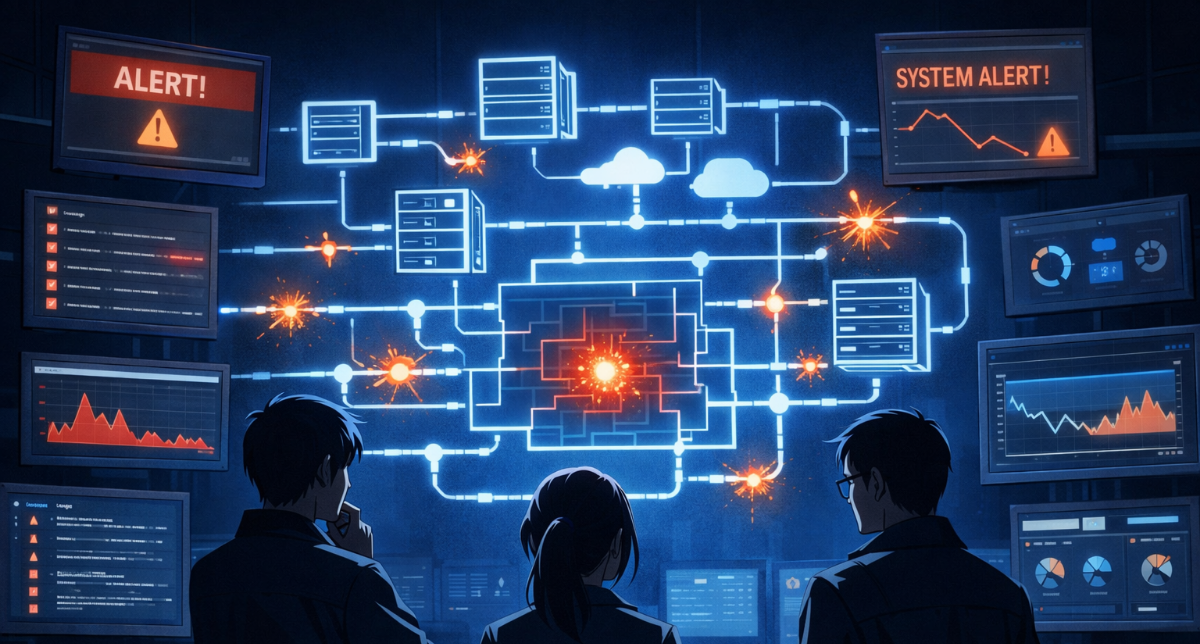
Many engineering organizations invest heavily in observability.
They deploy logging platforms.
They add tracing infrastructure.
They instrument metrics.
They build dashboards.
And yet incidents continue.
Pipelines still fail.
Systems still degrade unexpectedly.
Engineers still scramble during outages.
The problem is rarely a lack of observability tools.
It is a lack of visibility into how work actually flows through the system.
Why observability investments feel necessary
Observability investments usually follow a predictable pattern.
A system fails.
Teams struggle to diagnose the issue.
Logs are incomplete.
Metrics are missing.
Tracing is unclear.
The response is obvious: add more observability.
Organizations deploy tools for:
- centralized logging
- distributed tracing
- metrics aggregation
- alerting systems
- pipeline monitoring
These improvements are valuable.
But they do not automatically improve delivery reliability.
The misconception: more visibility equals more reliability
Observability improves visibility into systems.
But most delivery failures do not originate from unknown technical errors.
They originate from workflow friction across systems and teams.
For example:
- a pipeline depends on unstable upstream data
- approval processes delay fixes
- ownership boundaries prevent quick decisions
- infrastructure changes ripple downstream
In these situations, dashboards may show the symptoms.
But they do not solve the root cause.
This is the same structural problem described in:
Observability tools reveal technical signals.
They rarely reveal delivery constraints.
Why teams still struggle during incidents
Even with extensive observability tooling, incident response often looks chaotic.
Engineers search across multiple dashboards.
They correlate logs manually.
They check multiple systems.
This happens because the underlying workflow is fragmented.
Ownership spans multiple teams.
Dependencies cross infrastructure boundaries.
Decision authority is unclear.
So the observability system shows what is happening, but not why the failure propagated through the system.
This dynamic often overlaps with:
The signal exists.
But the operational context is missing.
Observability often amplifies symptom fixing
When observability tooling improves, teams detect problems faster.
But detection alone does not eliminate the cause.
Instead, teams respond faster to symptoms:
- restart pipelines
- reprocess jobs
- patch infrastructure
- rerun workflows
These fixes restore service.
But the root cause remains.
This is the same cycle that creates recurring delivery friction described in:
Over time, organizations become very good at reacting to failures instead of preventing them.
The missing layer: workflow observability
The observability gap most teams experience is not technical.
It is operational.
Traditional observability answers questions like:
- Is the pipeline running?
- Did latency spike?
- Which service returned errors?
But delivery reliability requires answering different questions:
- Who owns this workflow end-to-end?
- Where do approvals slow delivery?
- Which dependency repeatedly triggers incidents?
- Where does rework originate?
Without this workflow visibility, teams keep instrumenting systems without improving delivery flow.
Why AI and data pipelines amplify the problem
AI delivery pipelines are inherently complex.
They span:
- ingestion pipelines
- transformation layers
- feature pipelines
- model training workflows
- deployment infrastructure
- monitoring systems
Failures propagate across multiple layers.
Observability tools capture signals from each component.
But if ownership and workflow alignment are unclear, diagnosing the root cause still takes time.
This is why AI initiatives often drift even when infrastructure appears mature:
The systems work.
But the delivery pipeline remains fragile.
What high-performing teams do differently
Organizations that achieve stable delivery treat observability differently.
They combine technical observability with workflow visibility.
They focus on:
- mapping one critical workflow end-to-end
- clarifying ownership across systems
- reducing cross-team dependency loops
- stabilizing pipeline reliability
- identifying the few bottlenecks that trigger repeated incidents
Once those constraints are addressed, observability becomes far more effective.
Because the system itself becomes easier to understand.
If observability still feels insufficient
If your organization has strong monitoring but incidents still surprise teams…
If dashboards exist but diagnosing failures still takes hours…
If pipelines repeatedly fail despite extensive instrumentation…
The issue is probably not your observability stack.
It is your delivery architecture.
How to expose the real reliability constraint
A focused Data & AI Delivery Efficiency Audit maps one high-value workflow end-to-end and identifies:
- where delivery slows
- which dependencies trigger incidents
- where ownership breaks down
- which bottlenecks consume the most engineering time
- what structural fixes improve reliability fastest
Instead of reacting to symptoms, organizations can stabilize the system itself.
When observability starts working
Once the workflow constraint becomes visible, observability tools finally work the way teams expect.
Incidents become easier to diagnose.
Failures occur less frequently.
Engineering time shifts from firefighting to system improvement.
That is when delivery reliability begins to compound.
How to make delivery reliability visible
If observability investments have improved monitoring but reliability still feels fragile, the next step is structural clarity.
A Data & AI Delivery Efficiency Audit reveals where delivery friction actually originates and which fixes unlock the most capacity.