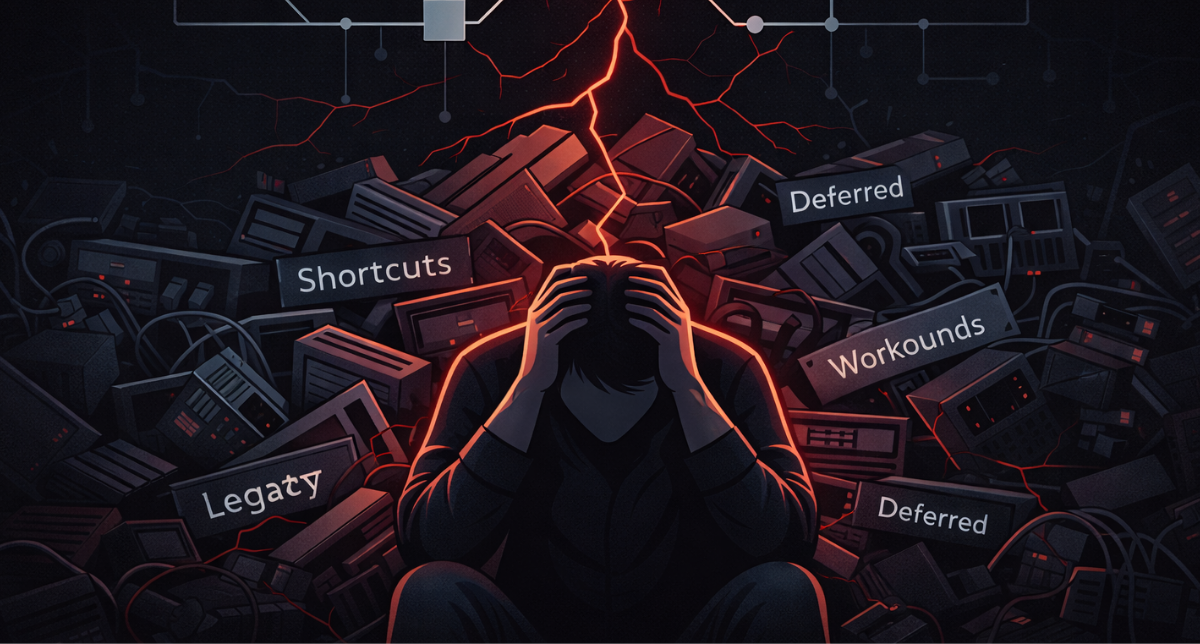
Most organizations don’t notice technical debt growing.
They notice it exploding.
For months, delivery feels slower but manageable.
AI initiatives are delayed but not dead.
Data pipelines are fragile but still running.
Compliance reviews take longer, but nothing is blocked permanently.
Then something shifts.
A release cascades into failures.
A model deployment triggers downstream issues.
A simple schema change causes days of rework.
A compliance review halts production.
Leadership asks:
“How did tech debt get this bad so suddenly?”
It didn’t.
It compounded.
Tech Debt Rarely Comes from One Big Mistake
Technical debt grows through small, normalized tradeoffs:
- manual workarounds in data pipelines
- undocumented transformations
- fragile orchestration logic
- unclear ownership across teams
- compliance steps bolted on late
- repeated short-term delivery tradeoffs
Individually, each decision feels reasonable.
Collectively, they increase system fragility.
This is the same invisible friction that causes teams to quietly lose weeks of delivery time
(see: how that invisible friction adds up to lost delivery days).
Why Tech Debt Appears to “Explode”
Technical debt becomes visible when:
- a critical AI initiative pushes pipeline limits
- regulatory scrutiny increases
- scale stresses fragile data architecture
- leadership demands faster delivery
- cross-team dependencies collide
At that point, the system can no longer absorb friction quietly.
What looked like small inefficiencies become delivery blockers.
This dynamic mirrors what happens when ownership breaks down inside pipelines
(see: Broken Pipelines or Broken Ownership?).
AI and Data Systems Amplify Technical Debt
AI delivery accelerates debt accumulation because it:
- depends on reliable data quality
- requires reproducibility and lineage
- spans engineering, analytics, ML, and compliance
- increases operational complexity
When AI is layered onto unstable foundations, fragility compounds faster.
This is why organizations lose ROI every month they delay stabilizing delivery foundations
(see: The ROI Lost Each Month You Delay AI).
Why Hiring More Engineers Doesn’t Solve Tech Debt
When tech debt explodes, the common reaction is to add headcount.
But adding engineers to a fragile delivery system increases:
- coordination overhead
- context switching
- integration complexity
- rework volume
Without workflow clarity, additional capacity amplifies friction.
This is the same pattern behind hidden workflow gaps that make AI projects late
(see: The Workflow Gap Making Every AI Project Late).
The Structural Causes of Exploding Tech Debt
Across enterprise environments, three root causes consistently appear:
1. Fragmented Ownership
No one owns delivery end-to-end.
Issues bounce between teams and accumulate silently.
2. Unmapped Workflows
Workflows exist across tools and teams but are never traced fully.
Hidden dependencies create late surprises.
3. Fragile Data Foundations
Pipelines “work” — until pressure increases.
Minor failures compound under scale.
These patterns also explain why data quality degrades under pressure
(see: Why Data Quality Drops Under Pressure).
How Organizations Prevent Sudden Tech Debt Crises
Stability doesn’t come from rewriting everything.
It comes from:
- tracing one high-value AI or analytics workflow end-to-end
- identifying where work stalls or repeats
- clarifying ownership boundaries
- quantifying rework and firefighting
- prioritizing thin-slice structural fixes
Momentum follows structural clarity.
This is the same approach used in focused delivery audits
(see: The Silent Cost of Late or Bad Data).
If This Feels Familiar
If delivery feels increasingly fragile…
If AI initiatives stall under scale…
If engineering capacity is consumed by rework…
If compliance risk feels higher every quarter…
Tech debt may already be compounding beneath the surface.
It doesn’t require a full transformation.
It requires visibility.
How Tech Debt Becomes Measurable
In focused Data & AI Delivery Efficiency Audits, technical debt is rarely abstract.
It becomes visible as:
- rework hours
- blocked initiatives
- pipeline instability
- compliance delays
- lost engineering capacity
The output is a quantified roadmap that stabilizes delivery foundations without expanding headcount or rebuilding your stack.