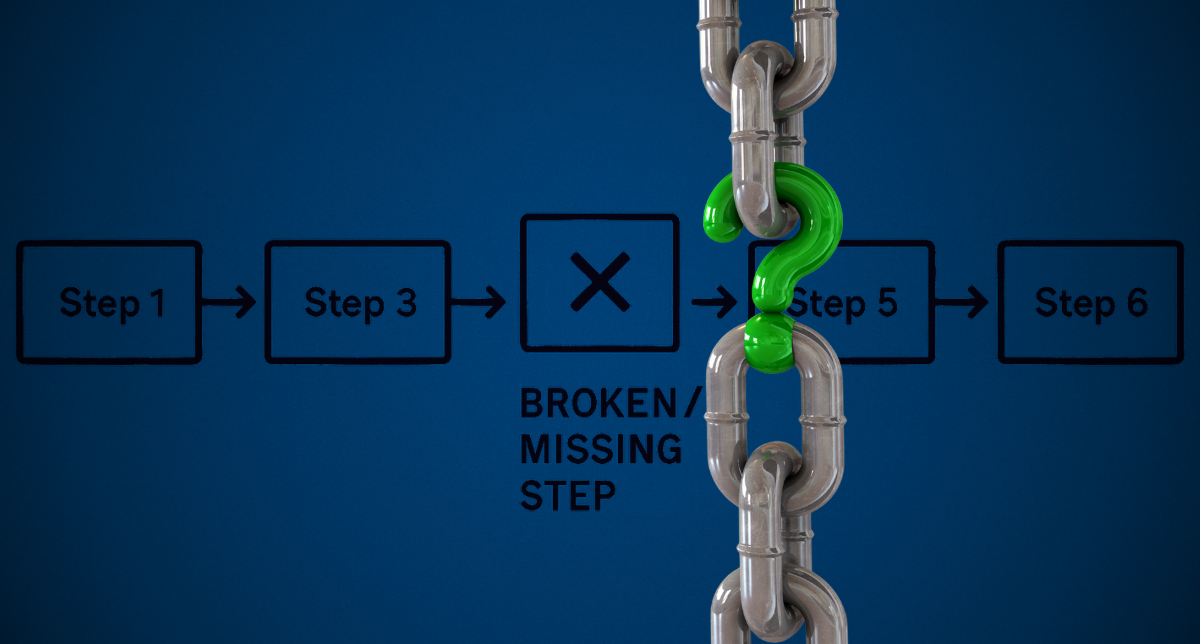
Most AI leaders are told their projects are slow because “compliance is blocking us” or “we just don’t have enough engineers.”
In reality, a large share of AI delivery delay comes from something less visible: a workflow that doesn’t exist as a single, coherent system.
When you follow one AI initiative from idea to production, you rarely see a clean flow.
Instead, you see a chain of handoffs spread across tools, teams, and meetings.
Product has one view.
Data science has another.
Platform and compliance each operate from their own checklists.
No one can sketch the entire delivery path on a single page.
That disconnect is the workflow gap.
How the workflow gap shows up for AI leaders
If you are accountable for AI, analytics, or data delivery, the workflow gap usually appears as:
- AI initiatives stuck in “pilot” far longer than expected
- Compliance reviews that arrive too late to be helpful
- Data readiness issues discovered after build has started
- Engineers spending more time reworking than building
- Roadmaps that slip without a clear technical root cause
- Leadership pressure without actionable explanations
These are not talent problems.
They are delivery visibility problems.
What the workflow gap looks like in practice
Work often jumps from “approved concept” straight into Jira tickets without a clear intermediate step that answers a basic question:
How does this initiative move end-to-end through data, engineering, and compliance — and who owns each decision?
Because that map is missing, the same failures repeat:
- Work begins before upstream data readiness is confirmed
- Compliance questions surface only after most of the build is complete
- Pipelines and environments are treated as afterthoughts
- Ownership shifts between teams without accountability
Each gap introduces delay that looks like something else.
Why AI delivery delays are misdiagnosed
From the outside, the symptoms are familiar:
Engineers appear “slow.”
Compliance feels like a blocker.
Leadership sees a roadmap that keeps slipping.
In reality:
Engineers are waiting on late decisions or re-doing work started on assumptions.
Compliance was never given an early, concrete view of the workflow and controls.
Leadership sees activity — not flow.
Traditional reporting does not expose this problem.
Burndown charts, status updates, and OKRs show whether tasks are done — not how many times work bounced between teams or how long it sat blocked mid-stream.
Why the workflow gap quietly creates rework
When teams operate from different mental models of how work flows, rework becomes inevitable.
Late surprises force resets.
Resets trigger rushed fixes.
Rushed fixes create fragile systems.
This is how AI initiatives drift quarter after quarter without formally failing
(see: The Real Reason Rework Never Stops in AI and Data Teams).
When the workflow gap becomes a business problem
The workflow gap stops being an inconvenience when:
- AI delivery timelines begin impacting revenue or cost savings
- Executive confidence in AI roadmaps erodes
- Compliance risk increases due to late-stage surprises
- Engineering morale drops under constant rework
- Leadership considers new tools or vendors to “fix” delivery speed
At this point, the issue is no longer technical.
It is operational.
This is also where ROI begins leaking quietly every month
(see: The ROI Lost Each Month You Delay AI).
How teams actually uncover the workflow gap
You cannot fix what you cannot see.
The workflow gap only becomes visible when you trace one real initiative in detail:
- Where does work enter the system?
- What must be true before anyone starts building?
- At which steps do decisions, approvals, or data checks arrive late?
- How many hours per month are lost to rework caused by unclear ownership?
Most teams never have the time — or neutrality — to do this themselves.
This is where focused delivery audits consistently surface hidden friction
(see: The Silent Cost of Late or Bad Data).
What changes when the workflow gap is closed
When workflows are explicit and owned end-to-end:
- Compliance reviews move earlier and faster
- Engineering throughput increases without adding headcount
- Roadmaps stabilize
- AI initiatives leave “pilot” more predictably
- Rework drops sharply
Delivery becomes intentional instead of reactive.
How to identify your biggest workflow gap
A Data & AI Delivery Efficiency Audit focuses on one high-value workflow and shows:
- how work actually flows today (not how it is documented)
- where time is lost to handoffs, rework, or late decisions
- how many hours are leaking each month
- which fixes return the most capacity fastest
- what to change first — without adding headcount or tools
The output is a focused, quantified roadmap — not another process layer.
If your AI initiatives are technically feasible but delivery remains slow,
the bottleneck is rarely talent or technology.
It is usually an invisible workflow that everyone is following and nobody has drawn.