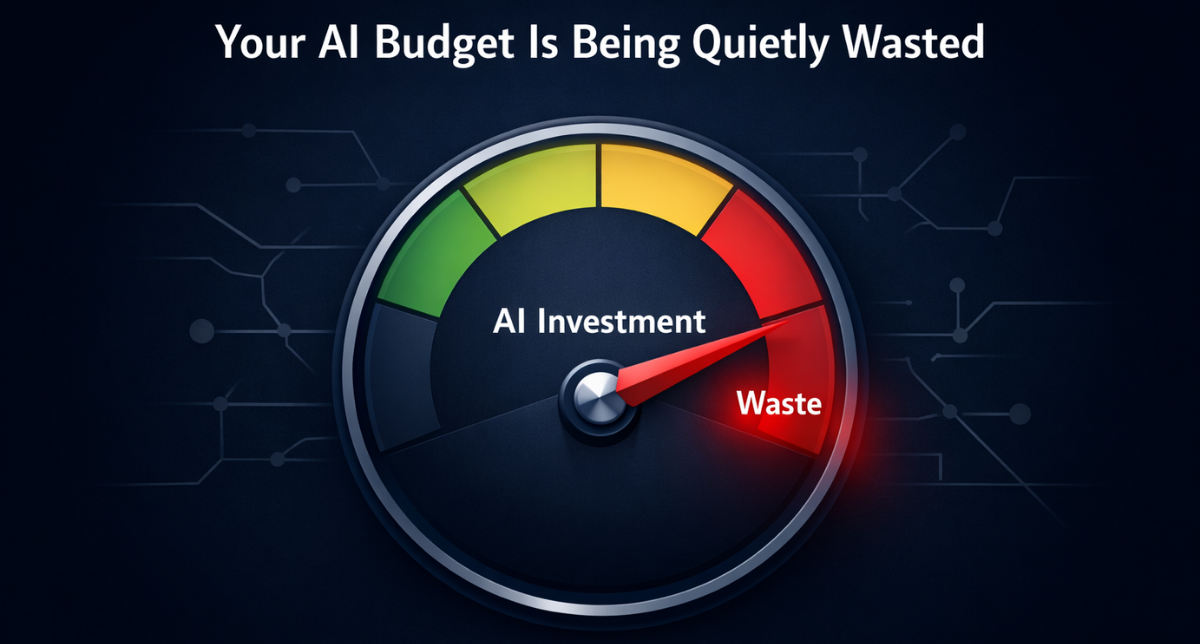
Most AI budgets do not collapse in a single failed launch.
They erode quietly.
A delayed deployment.
A reset caused by late data.
A compliance redesign.
A pipeline stabilized “one more time.”
Individually small.
Collectively expensive.
Where AI budgets actually leak
Across AI-heavy organizations, budget erosion typically originates from workflow friction rather than tooling decisions.
1. Rework caused by late inputs
Work begins before upstream data, governance alignment, or decision clarity is fully resolved.
Late surprises force resets.
Resets consume senior time.
Capacity disappears.
2. Fragile pipelines under pressure
Pipelines technically function — but reliability degrades under production scale.
Senior engineers become permanently embedded in stabilization efforts.
Forward progress slows.
This is the same dynamic that quietly turns a healthy-looking budget into a wasted one
(see: where the wasted days behind that budget actually come from).
3. Compliance introduced too late
Controls are layered in after development.
Design changes ripple backward.
Models stall in review.
Rework compounds.
4. Fragmented ownership
Engineering owns ingestion.
Analytics owns transformation.
ML owns modeling.
Platform owns infrastructure.
No one owns end-to-end business outcome.
This fragmentation is one of the most common root causes of delivery erosion
(see: Broken Pipelines or Broken Ownership?).
5. Firefighting displaces strategic work
Senior engineers spend more time unblocking than building.
Headcount remains constant.
Effective output drops.
This is how AI initiatives drift quarter after quarter
(see: The ROI Lost Each Month You Delay AI).
Why more budget rarely fixes it
When organizations respond by increasing headcount or tooling, they often scale existing inefficiencies.
More engineers inside unclear workflows increase coordination cost.
More tooling layered on fragile systems increases complexity.
Without visibility into delivery friction, additional budget amplifies waste.
The real constraint on AI ROI
AI ROI is constrained by:
- upstream visibility gaps
- unclear ownership
- fragile handoffs
- hidden rework
- late-stage governance friction
- senior capacity lost to firefighting
Until those are addressed, budget increases will not accelerate delivery.
How organizations stop the leak
Organizations that reclaim AI ROI do not launch multi-year transformations.
They trace one high-value AI or analytics workflow end-to-end and quantify:
- where time is being lost
- why resets occur
- which bottlenecks matter most
- what fixing them would return in capacity
Once friction is visible, fixes are often smaller and faster than expected.
Why focused engagements outperform large programs
Most organizations do not need more engineers.
They need clarity.
Fixing the top one or two delivery bottlenecks often returns more effective capacity than months of hiring.
This is why short, focused audits produce outsized impact.
How to quantify hidden AI budget erosion
A Data & AI Delivery Efficiency Audit surfaces:
- workflow bottlenecks
- ownership breakdowns
- pipeline reliability issues
- senior engineering toil
- compliance sequencing problems
- estimated capacity loss per month
- a focused 90-day acceleration plan
The result is a quantified roadmap — not another process layer.