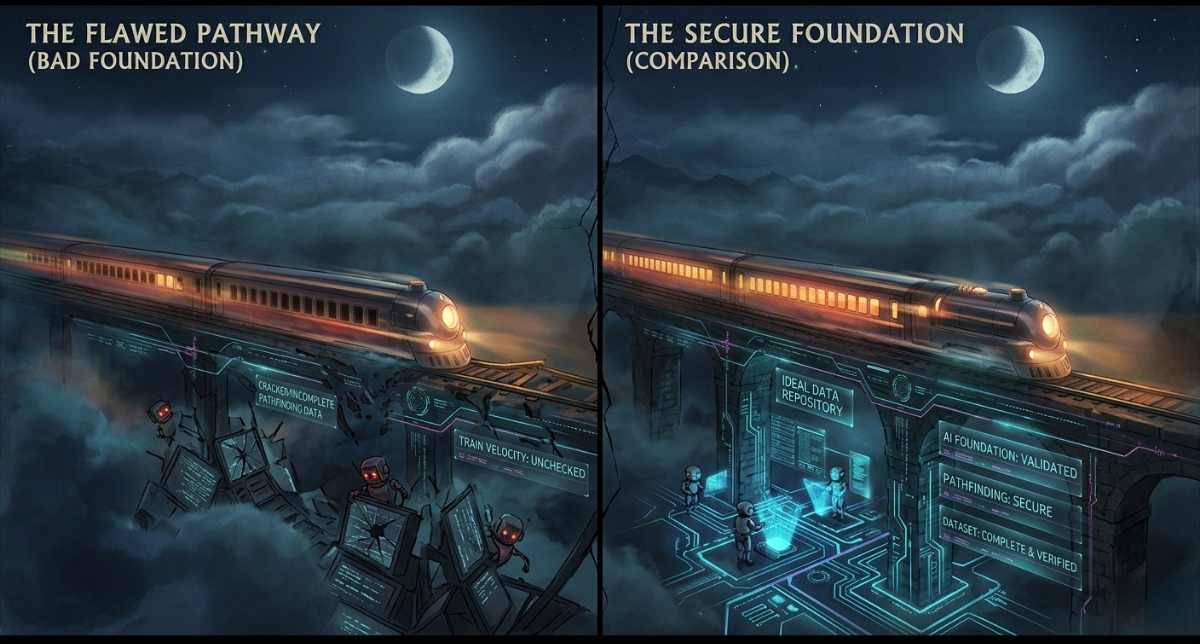
The AI roadmap has twelve initiatives.
Leadership is aligned.
The strategy deck is polished.
The board approved the investment.
The data infrastructure can reliably support two of them.
This is one of the most common and least discussed sources of AI delivery failure. Organizations invest heavily in what AI will do — and underinvest in whether the data foundation can actually support it.
Why AI ambition always runs ahead of data reality
AI strategy is set at the executive level.
It is shaped by what competitors are doing, what vendors are demonstrating, and what the market is demanding.
Data infrastructure is built incrementally by engineering teams, shaped by historical decisions, technical debt, and organizational constraints.
These two systems evolve at completely different speeds.
The strategy moves fast — by design.
The foundation moves slowly — also by design.
When strategy pulls far ahead of foundation, every AI initiative that begins without the data infrastructure to support it will eventually stall — requiring rework or abandonment.
This is how organizations spend millions on AI roadmaps that produce little measurable impact:
What happens when strategy outpaces foundation
Initiatives launch into unstable data environments
Models built on unreliable data pipelines produce unreliable outputs.
When those outputs fail in production — or fail to reach production — teams scramble to fix the data layer while simultaneously trying to deliver the AI initiative.
The result is rework that compounds:
Teams spend their time unblocking data, not building AI
When the data foundation is unstable, data scientists and ML engineers spend a disproportionate amount of time waiting for clean inputs, debugging pipeline failures, and filing requests to upstream teams.
This is not AI delivery.
It is data maintenance masquerading as AI delivery.
Governance gaps appear at the worst moment
AI strategies frequently include use cases with significant governance and compliance requirements — customer data, financial data, regulated industries.
When the data strategy hasn’t addressed lineage, access controls, and audit trails, compliance requirements surface mid-initiative and force costly rework or delays:
The signals your data strategy is behind
Most organizations recognize the gap only after they begin building.
Earlier signals include:
- AI initiatives consistently take longer than planned without clear technical explanation
- the same data quality issues appear across multiple AI projects
- data engineering capacity is consumed by support requests from AI teams
- compliance reviews are requesting data documentation that doesn’t exist
- the organization has a defined AI strategy but no defined data product roadmap
If more than two of these are true, the foundation is already constraining delivery.
Why “we’ll fix data as we go” doesn’t work
The most common response to this gap is to address data issues reactively — fixing problems as they surface during AI initiative development.
This approach has a predictable cost.
Each data fix discovered mid-initiative requires rework upstream and downstream. The AI team loses days or weeks. The fix often introduces new instability elsewhere. Confidence in the data layer erodes.
Over time, the organization becomes expert at fixing data problems — and slow at delivering AI outcomes:
The only way to break this pattern is to build the foundation ahead of the initiatives that depend on it.
The single-source myth
Many organizations believe a unified data platform will solve the alignment problem.
It rarely does.
The problem is not where data lives. It is whether data is reliable, governed, and owned.
A single data warehouse with inconsistent quality and unclear ownership produces the same delivery failures as a fragmented architecture:
What alignment actually looks like
Organizations that consistently deliver on their AI strategies share one characteristic:
Their data strategy is defined at the same level of rigor as their AI strategy.
That means:
- critical data domains are identified and owned before AI initiatives begin
- data quality standards are defined and enforced upstream
- pipeline reliability is treated as a first-class engineering concern
- compliance and lineage requirements are addressed at the data layer, not at the AI layer
- data product availability is part of the AI initiative roadmap, not an assumption
This is not a data transformation program. It is a deliberate decision to treat the foundation as a strategic asset — not an implementation detail.
If your AI strategy is stalling at the data layer
If AI initiatives consistently surface data problems mid-development…
If data engineering is a bottleneck on every AI project…
If governance requirements keep arriving late and forcing rework…
The problem is not the AI team.
It is the gap between the strategy they were given and the foundation they were handed.
Closing that gap starts with making it visible.
How to close the strategy-foundation gap
A focused Data & AI Delivery Efficiency Audit maps one AI initiative end-to-end and identifies:
- where data quality gaps are slowing delivery
- which pipeline reliability issues create the most risk
- where governance requirements arrive too late
- how much delivery time is lost at the data layer
- which data investments would unlock the most AI delivery capacity