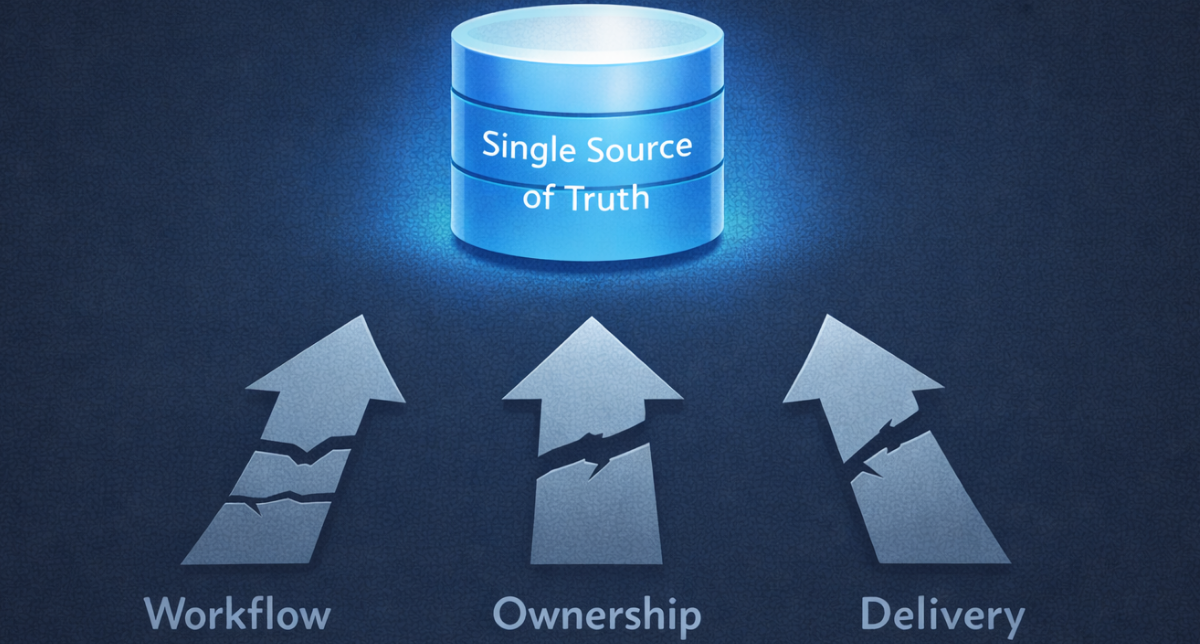
Most organizations believe that building a single source of truth will solve their AI and data delivery problems.
It rarely does.
Modern warehouses, centralized dashboards, and semantic layers improve data location — but they do not fix delivery friction.
If your AI initiatives are slow despite strong data infrastructure, the bottleneck is not centralization.
It is workflow clarity, ownership, and operational alignment.
Why “Single Source of Truth” Became the Default Strategy
Centralization feels safe.
When teams experience: - inconsistent data - conflicting reports - unclear metrics - unreliable dashboards
The instinct is consolidation.
So organizations invest in: - a modern cloud data warehouse - enterprise BI tools - governance frameworks - master data management - centralized analytics platforms
These improvements matter.
But they do not address the root cause of slow AI delivery.
That pattern shows up repeatedly in: - Why Your Team Is Wasting 20+ Days Every Month Trying to Deliver AI With Unreliable Data Workflows - The Workflow Gap Making Every AI Project Late
Centralization Does Not Fix Workflow Friction
You can have a pristine warehouse and still suffer from:
- delayed handoffs
- unclear ownership
- repeated compliance reviews
- rework loops
- fragile pipelines
- model approval bottlenecks
This is the same pattern described in: - Broken Pipelines or Broken Ownership? - The Silent Cost of Late or Bad Data
The issue is not data location.
It is delivery architecture.
The Hidden Cost of “Almost There”
Many organizations feel close.
They believe:
“We’ve centralized. We’re almost ready.”
But being “almost ready” often creates false confidence.
See: - The False Security of ‘We’re Almost There’
This false security delays deeper structural fixes.
Why AI Initiatives Still Drift
AI delivery amplifies small workflow inefficiencies.
Even with centralized data:
- feature engineering spans teams
- validation requires approvals
- compliance slows iteration
- pipeline fragility creates firefighting
Over time, the drift compounds.
As outlined in: - The ROI Lost Each Month You Delay AI - What AI Delays Really Cost the Business
The opportunity cost is rarely measured — but it accumulates.
Single Source of Truth vs Single Owner of Flow
The organizations that accelerate AI delivery focus on:
- one critical workflow
- explicit end-to-end ownership
- clear decision rights
- removal of redundant reviews
- quantified friction
- stabilized reliability
They fix flow first.
Then tooling supports it.
Not the other way around.
If You Recognize This Pattern
If your data platform is modern but delivery feels unstable…
If dashboards exist but decisions lag…
If AI projects stall in review cycles…
The issue is not your single source of truth.
It is fragmented ownership and hidden workflow friction.
That is measurable.
And fixable.
How to Surface the Real Constraint
A focused Data & AI Delivery Efficiency Audit maps one high-value workflow end-to-end and identifies:
- where accountability breaks
- how much time is lost each month
- where rework originates
- which decisions require cross-team approval
- what to fix first for immediate acceleration
No new headcount.
No stack rebuild.
No massive transformation program.