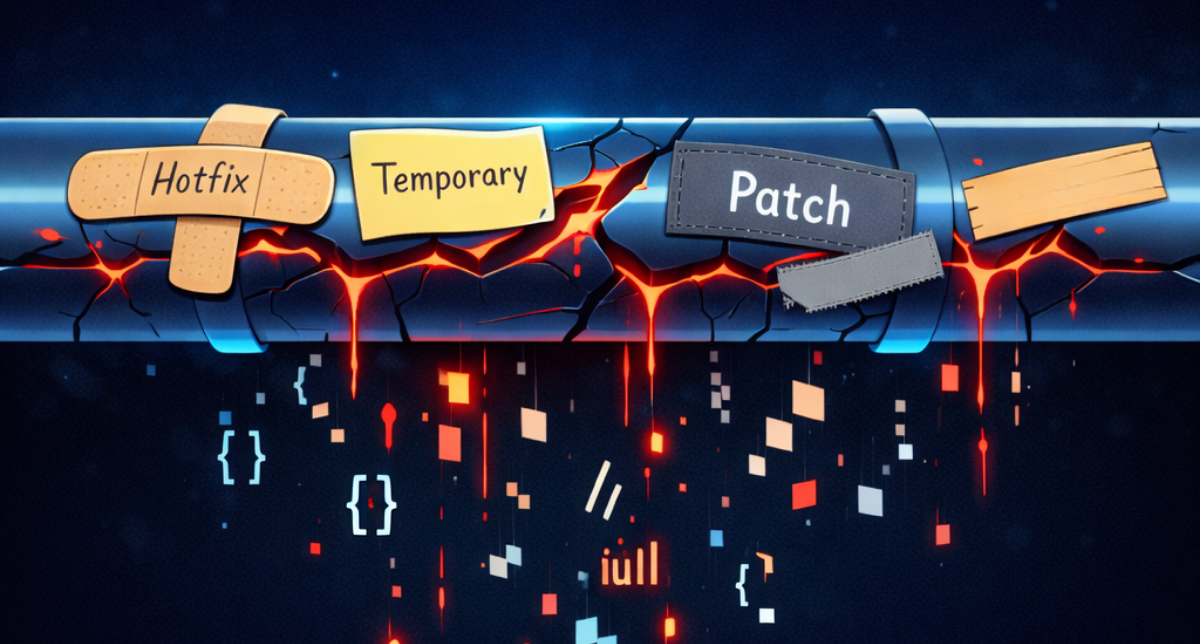
The Hidden Cost of “Quick Fix” Data Patches
Quick SQL fixes. Temporary overrides. Manual CSV adjustments. Hardcoded logic “just for now.”
Most data teams rely on them.
Few measure their long-term impact.
What starts as a responsible hotfix often becomes the foundation of future delivery friction.
If your organization struggles with slow AI initiatives, fragile pipelines, or recurring incidents, quick fix data patches may be the silent cause.
Why Quick Data Fixes Feel Efficient
Quick patches help teams:
- Meet executive deadlines
- Close production incidents
- Calm stakeholders
- Avoid missed commitments
They appear pragmatic.
But they quietly introduce architectural divergence.
And divergence compounds.
How Data Patch Debt Accumulates
1. Temporary Logic Becomes Permanent
Downstream dashboards adapt to it.
Pipelines incorporate it.
Analysts assume it’s canonical.
Without documentation, the patch becomes institutional memory.
This is similar to the rework patterns discussed in The Real Reason Rework Never Stops.
2. Ownership Disappears
Who added the override?
Why was it necessary?
Is it still required?
When ownership fades, removal becomes risky.
Now delivery slows because no one wants to touch the system.
3. Pipeline Fragility Increases
Each additional patch:
- Increases testing complexity
- Raises regression risk
- Expands hidden dependencies
- Slows iteration cycles
Over time, leadership experiences what feels like sudden instability.
In reality, this is the same compounding pattern explained in Why Tech Debt Explodes Suddenly.
4. Data Trust Erodes
Quick patches don’t just affect engineering.
They impact:
- Executive decision confidence
- Metric reliability
- Compliance validation
- AI readiness
This connects directly to the patterns outlined in The Silent Cost of Late or Bad Data.
Why AI Projects Stall Because of Patches
Many AI delivery failures are blamed on:
- Model performance
- Talent gaps
- Tooling choices
But the real blockers often include:
- Undocumented transformation layers
- Manual correction steps
- Hardcoded business logic
- Fragile data lineage
Which mirrors the systemic issues discussed in:
- The Workflow Gap Making Every AI Project Late
- Why Your Team Is Wasting 20 Days
- The ROI Lost Each Month You Delay AI
The Real Cost of Quick Fix SQL Patches
The cost is not the original hotfix.
The cost is:
- Increased change risk
- Slower delivery velocity
- Compounding rework
- Reduced observability
- Organizational hesitation
Over time, patch debt becomes delivery friction.
What High-Performing Data Teams Do Differently
They:
- Assign explicit owners to temporary patches.
- Add expiration dates to hotfix logic.
- Track overrides in lineage tooling.
- Review patches quarterly.
- Replace manual corrections with durable automation.
They treat quick fixes as debt instruments — not permanent architecture.
Final Thought
Quick fixes are not the enemy.
Invisible ones are.
If your AI or analytics initiatives feel slower each quarter, the root cause may not be your models or your tools.
It may be years of accumulated patch debt embedded inside your workflows.
Start by mapping a single pipeline from request to production.
The friction will become visible.