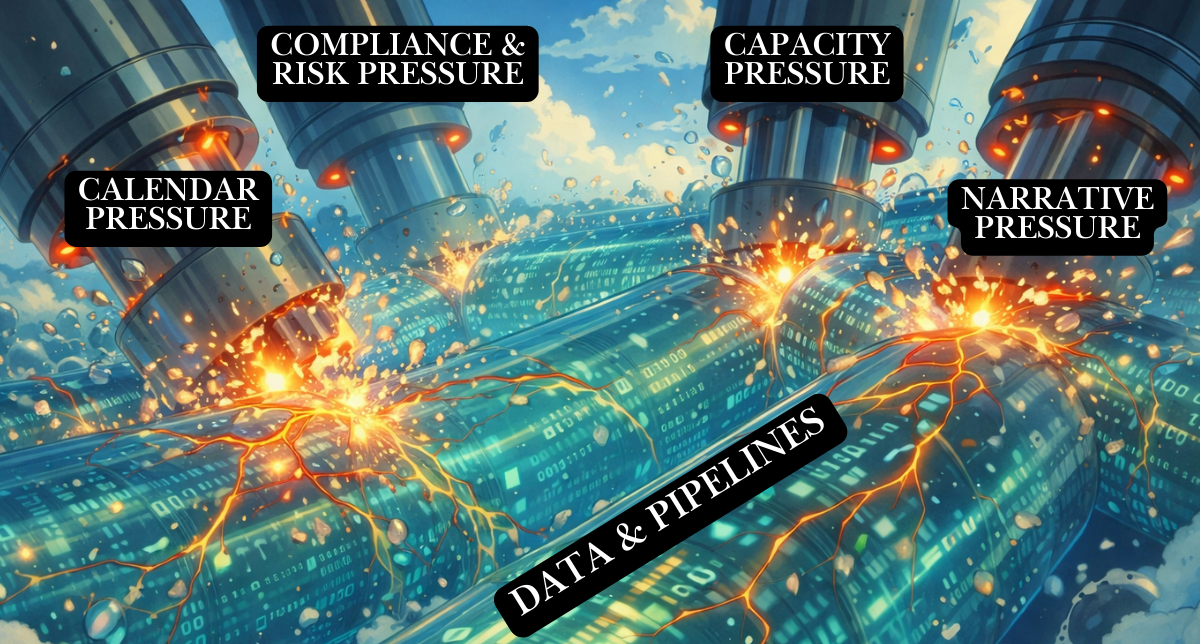
Most organizations think data quality problems are about checks, rules, or tooling.
They aren’t.
Data quality usually looks acceptable — until pressure hits.
A tighter deadline.
A production incident.
A compliance review.
A high-value AI use case pushed faster than planned.
That’s when quality drops, confidence disappears, and delivery slows.
Data quality doesn’t fail in isolation
When quality degrades, teams often focus narrowly on:
- missing validation rules
- bad test coverage
- edge cases
But in practice, data quality failures are rarely isolated.
They are signals of adjacent delivery problems already present in the system.
Across delivery audits, quality drops almost always coincide with:
- rework loops becoming normalized
- pipeline fragility increasing
- ownership breaking at handoffs
- late-stage approvals blocking releases
- senior engineers pulled into firefighting
Quality is not the root cause.
It is the symptom.
Why data quality appears stable in calm conditions
In steady-state environments:
- pipelines run predictably
- manual fixes are tolerable
- tribal knowledge fills gaps
- experienced engineers quietly intervene
Quality appears “good enough.”
But this stability is artificial.
It depends on:
- low change volume
- slack in timelines
- people compensating for weak workflows
This is the same dynamic that allows rework to quietly become the default workflow
(see: The Real Reason Rework Never Stops in AI and Data Teams).
What pressure actually reveals
When pressure increases, hidden delivery weaknesses surface fast.
Common patterns include:
- pipelines rerunning or failing more frequently
- late or partial data entering downstream systems
- manual fixes being skipped to hit deadlines
- assumptions breaking across teams
- rework exploding near release or audit windows
Teams shift from prevention to survival.
Dashboards lose credibility.
Models drift.
Approvals slow down.
This is why quality issues feel sudden — even though the causes were present all along.
Why better data quality checks don’t fix the problem
Most organizations respond by:
- adding more validation rules
- expanding observability
- increasing documentation
These measures improve detection.
They do not improve delivery under pressure.
Because the real issue is where quality enters the workflow:
- validation happens too late
- ownership is unclear when data changes
- handoffs introduce ambiguity
- fixes are applied downstream instead of upstream
This is the same reason pipeline reliability problems quietly collapse AI velocity
(see: The Workflow Gap Making Every AI Project Late).
Data quality failures are a leadership visibility problem
Teams feel quality degradation immediately.
Leadership typically sees it only when:
- incidents occur
- audits raise flags
- AI milestones slip
By then, quality issues are already coupled with:
- lost delivery time
- increased rework
- eroding trust in outputs
From the outside, this looks like unpredictability.
From the inside, it’s accumulated delivery debt finally surfacing
(see: The Silent Cost of Late or Bad Data).
What actually stabilizes quality under pressure
Teams that maintain data quality during high-pressure periods don’t chase perfection.
They do one thing differently:
They trace one real data or AI workflow end-to-end and make adjacent failures visible:
- where bad data enters
- where validation arrives too late
- where ownership breaks
- where rework consumes capacity
- where latency or approvals stall flow
That visibility changes decisions quickly.
This is the same approach that surfaces the bottlenecks stealing months from AI teams
(see: Three Bottlenecks That Steal Months from AI Teams).
What resilience actually looks like
A resilient workflow isn’t one that never breaks under pressure — it’s one where the team already knows exactly where it will bend, because someone traced it before the pressure hit.
That’s the real difference between a team that survives a tight deadline and one that doesn’t: not more validation rules, but knowing in advance which single workflow will crack first, and having already moved its weakest point earlier in the process.
If this feels familiar
If data quality holds until timelines tighten.
If AI initiatives slow under scale or scrutiny.
If audits trigger last-minute fixes.
You may not have a tooling problem.
You may have adjacent delivery failures that only surface under pressure.
Finding the crack before the pressure does
Rather than waiting for the next deadline or incident to expose fragility, trace the workflow that matters most and ask where it would break first under load. That answer is almost always the same place quality problems have already been quietly showing up — just not loudly enough yet to get attention.
Fixing that one point ahead of time is a smaller job than fixing it during an incident, and it usually resolves several “unrelated” quality complaints at once.
How to assess data quality risk in context
The honest test is a simple one: pick your highest-stakes workflow and ask what happens to its data quality during the worst week of the quarter, not the average one. Whatever breaks first under that scenario is the real risk — and it’s usually fixable well before the next deadline forces the question.