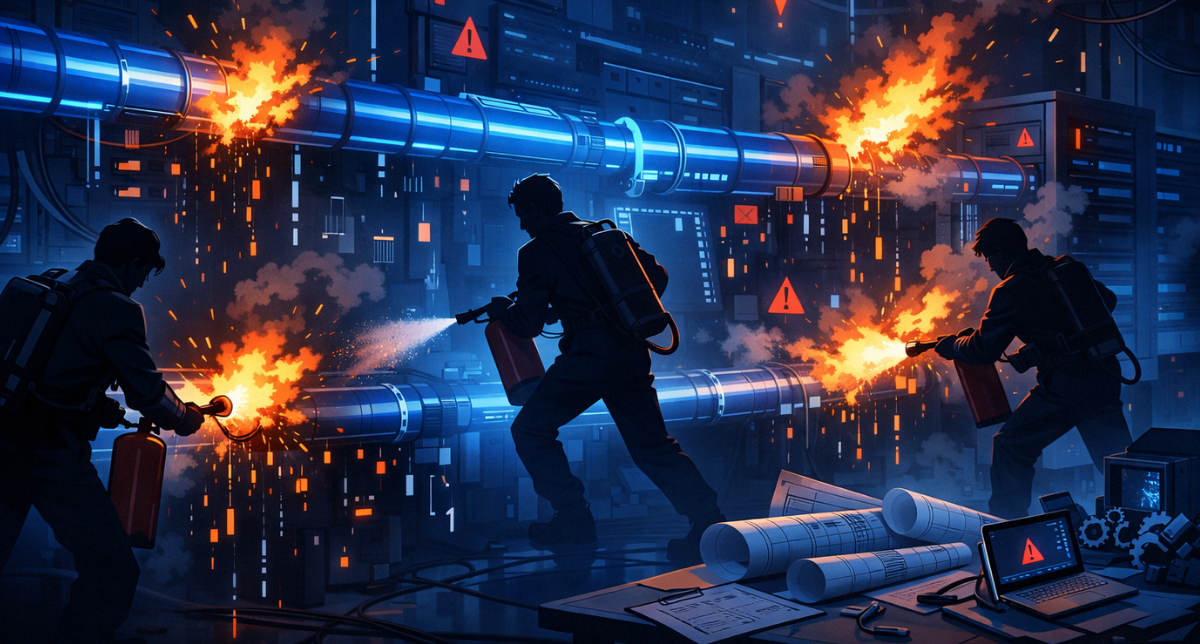
In many engineering organizations, the most experienced engineers are also the most interrupted.
They are the ones pulled into incidents, broken pipelines, emergency fixes, and urgent debugging sessions.
At first, this feels reasonable.
Senior engineers solve complex problems quickly.
So when something breaks, escalation flows upward.
But over time something subtle happens.
The people best positioned to improve the system spend most of their time stabilizing it instead.
And that quietly slows every AI, data, and engineering initiative the organization is trying to deliver.
Why senior engineers get pulled into constant incidents
Most organizations unintentionally create an escalation pattern that looks like this:
- A system breaks or a pipeline fails
- A junior engineer attempts the fix
- The issue escalates because the root cause is unclear
- A senior engineer gets pulled in
- The problem is solved quickly
The system stabilizes.
But the deeper issue remains untouched.
Because the fastest way to restore service is usually patching the symptom, not redesigning the architecture.
Over time, this pattern repeats.
Eventually, senior engineers become the default incident response team, even when that was never the plan.
This is closely related to the delivery friction described in:
How escalation patterns become the default
Escalation patterns persist for a simple reason:
They work in the moment.
Incidents get resolved.
Systems come back online.
Leadership sees problems handled.
But the long-term cost remains hidden.
The same problems keep reappearing because the underlying workflow, architecture, or ownership model never changes.
This dynamic frequently overlaps with fragmented ownership structures described in:
When ownership is unclear, escalation becomes the easiest way to move work forward.
Firefighting prevents architecture improvements
Senior engineers are typically responsible for the work that prevents incidents:
- platform architecture
- pipeline reliability
- automation initiatives
- observability improvements
- reduction of technical debt
But those improvements require uninterrupted time.
Firefighting destroys that time.
Instead of improving systems, senior engineers spend their weeks:
- debugging data pipelines
- handling escalations across teams
- resolving production incidents
- patching fragile infrastructure
The architecture work that would eliminate incidents never gets done.
System fragility compounds over time
Every temporary fix introduces small structural risks:
- patches added under time pressure
- pipelines extended without redesign
- monitoring added without root cause fixes
- manual checks inserted into workflows
Individually these changes feel small.
Collectively they slowly increase system fragility.
This is why data reliability quietly degrades in operational environments
(see: The Silent Cost of Late or Bad Data).
And once fragility increases, incidents become more frequent.
Which pulls senior engineers into even more firefighting.
The cycle reinforces itself.
Why this slows AI and data delivery
AI delivery depends heavily on stable pipelines and predictable workflows.
When systems are fragile:
- data pipelines break frequently
- model training pipelines stall
- feature pipelines require manual intervention
- monitoring becomes reactive instead of preventative
Teams spend their time stabilizing infrastructure instead of delivering capabilities.
This is how organizations quietly lose weeks of engineering capacity every month
(see: Why Your Team Is Wasting 20+ Days Every Month).
And once rework becomes normal, delivery timelines drift without anyone fully understanding why
(see: The Real Reason Rework Never Stops).
Over time, the opportunity cost becomes significant:
Why firefighting becomes the culture
Once escalation patterns are established, organizations unintentionally optimize around them.
Engineers become known for their ability to rescue failing systems.
Incident response becomes a badge of honor.
But the structural problems persist.
This is why many organizations feel perpetually close to solving delivery problems without ever stabilizing them.
See also:
What high-performing teams do differently
Organizations that escape this cycle change how they allocate senior engineering time.
They do three things differently.
Protect architecture time
Senior engineers must have protected time to improve systems instead of constantly responding to incidents.
Reduce escalation dependency
High-performing teams invest in:
- clearer ownership
- operational playbooks
- automated diagnostics
- better monitoring
This reduces unnecessary escalation.
Stabilize one workflow first
Instead of trying to fix everything, strong teams identify one critical workflow and remove the bottlenecks that repeatedly trigger incidents.
That single improvement often eliminates multiple downstream failures.
If your senior engineers are constantly firefighting
If your most experienced engineers spend most of their time resolving incidents instead of improving systems, the issue is rarely staffing.
More often, it is delivery architecture.
Escalation patterns, fragile pipelines, and unclear workflow ownership quietly absorb engineering capacity long before leadership notices.
How to make firefighting visible
A focused Data & AI Delivery Efficiency Audit traces one high-value workflow end-to-end and identifies:
- where escalation originates
- where architecture improvements are blocked
- how much senior engineering capacity is lost each month
- where rework compounds across teams
- which changes restore delivery flow fastest
The output is a focused roadmap — not another transformation program.